

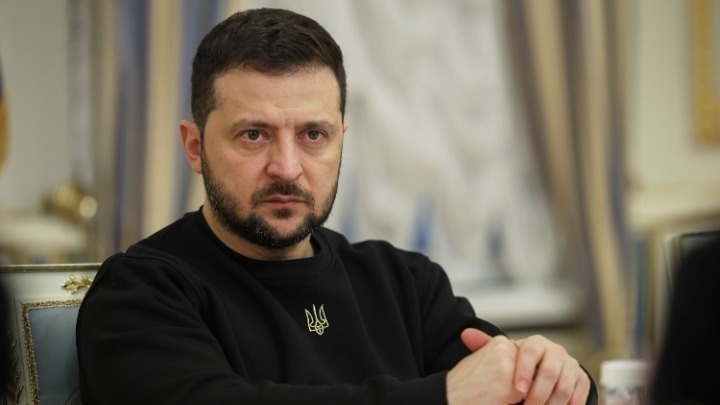
Ukrainian President Volodymyr Zelensky announced today that he has returned to Poland the highest distinction he had been awarded, after his Polish counterpart decided to strip it of it, against the backdrop of the crisis in relations between the two neighboring countries related to the interpretation of events in their common history.
“We thought that the Order of the White Eagle, awarded in 2023, was intended for the Ukrainian people and our army. This was stated at the time,” Zelensky wrote in a post on social media. However, he assured that Ukraine “remains open to any form of substantive engagement with Poland in order to avoid contradictory interpretations of the difficult and painful chapters of our common past.”
Polish President Karol Nawrotski announced on Friday that he would strip his Ukrainian counterpart of the Order of the White Eagle because the latter decided in May to name a military unit after the Ukrainian Revolutionary Army (UPA), a nationalist organization that operated during World War II and is considered by Warsaw to be responsible for the deaths of more than 100,000 Poles.
In protest, several Ukrainian officials announced that they would return the distinctions granted to them by Poland in recent years, including Foreign Minister Andriy Sibikha, the Ukrainian ambassador to Warsaw, and the head of the Ukrainian President’s Office, Kyrylo Budanov. The latter argued that Navrotsky’s decision is a “gift” to Russia, which “will not fail to use it against our countries.”
From Moscow, former Russian president and former prime minister Dmitry Medvedev expressed satisfaction with the Polish president’s move, accusing Kiev of “ties” with Nazism.
The UPA was the military wing of a Ukrainian separatist movement that fought against the Red Army but also clashed with the Polish resistance and killed Polish and Jewish civilians. The UPA at times collaborated with the Nazis, while at other times it turned against them.
According to Poland, the actions of the UPA amount to ethnic cleansing and genocide. Ukraine recognizes the massacres but rejects the term genocide, preferring to speak of a tragic conflict against the backdrop of war.
Polish Prime Minister Donald Tusk, a staunch supporter of Ukraine, also commented on Platform X: “the conflict between Poland and Ukraine delights Putin and shocks our allies.”