

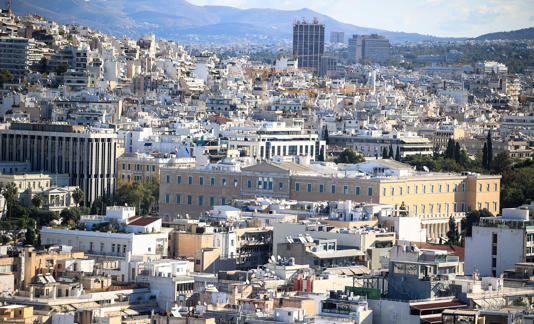
If one tries to describe in one sentence the current picture of the Greek housing market, two numbers may suffice. Nearly three out of four homes purchased in 2025 were over twenty years old, while newly built homes accounted for a much smaller segment of transactions. The data of REMAX Hellas that have seen the light of day reflect a reality that now characterizes the entire market. Demand for housing remains strong, but the supply of new properties is not enough to cover it. As a result, a large number of buyers are turning to older apartments and homes, looking for solutions in a market that is constantly evolving and poses new questions about the value, energy efficiency, financing and future capital gains of real estate.
Residences dominate transactions
More specifically, according to REMAX Hellas data, 74.8% of the purchases and sales carried out in 2025 concerned residences. This was followed by plots of land with a percentage of 14.3%, parcels of land with 5.8% and commercial real estate with 5.1%. This picture confirms that housing continues to be the main choice of real estate buyers in Greece. But where the picture becomes even more interesting is in the age of real estate. According to the REMAX Hellas survey, 75.6% of homes sold in 2025 were over 20 years old. In contrast, newly built properties up to five years old accounted for only 12.3% of total sales. Properties aged 16 to 20 collected a percentage of 9.8%, those aged 11 to 15 a percentage of 2%, while houses aged 6 to 10 years only 0.3%. The limited construction of new homes in previous years has created a gap between demand and supply. Thus, many buyers end up with older properties, as these make up the bulk of the available inventory. On the other hand, where there is the possibility of buying a newly built home, it continues to attract strong interest thanks to its modern features and higher energy efficiency.
The picture in the major markets
This trend is even more pronounced in large urban centers. In Attica, residential properties accounted for 85.3% of total sales made through the REMAX Hellas network. Commercial real estate and land occupied 7.2% each, while parcels of land were limited to 0.3%. At the same time, the land market recorded an increase of 1.8% compared to the previous year. In terms of the age of the properties, 86.2% of the houses that changed hands were over 20 years old, while newly built up to five years old were limited to 3.3%. The picture is similar in Thessaloniki. Houses accounted for 87.4% of total sales, while 87% of homes sold were over 20 years old. Newly built up to five-year-olds covered only 2% of all transactions. In the rest of Greece, houses still have the largest share, with a percentage of 69.4%, but plots occupy a more important space in the market, reaching 18.3% of total sales. In the region, there is also a greater presence of newly built properties, as houses up to five years old account for 17.9% of transactions, a percentage significantly higher than that of Attica and Thessaloniki.
Buying a home now requires more knowledge
The picture captured by market data explains why the process of buying a home is becoming increasingly complex. In the book “Buying a House” by Stratos Paradias (president of POMIDA) and Ilias Papageorgiadis (real estate investor-analyst), published by Kastaniotis Publications, an attempt is made to gather the basic knowledge that an interested party needs before proceeding with the purchase of a permanent residence. In the foreword of the book, the Governor of the Bank of Greece, Yannis Stournaras, notes that the decision to acquire a home is one of the most important in every person’s life and requires knowledge, planning and responsibility. Among other things, the two authors give as a first rule the choice of the right location. The place of work, daily commutes and family prospects have a decisive influence on the choice of an area. Equally important is the size of the property, as a house can turn out to be either larger or smaller than what a household really needs. They pay particular attention to age, renovation and energy upgrade. As they point out, the evaluation of these parameters requires the contribution of experts, while the energy condition of a property is expected to become even more important in the coming years. Their advice also includes the choice of floor, the value of the auxiliary spaces, the operation of the apartment building, the utilities, the relationships with the co-owners and, finally, the need to have a balance between the wishes and the real financial capabilities of the buyer.
Energy upgrade becomes a decisive factor
Energy efficiency is emerging as one of the most important factors of the next decade. According to what is stated in the book, insulation, heating, solar water heater and lighting directly affect the energy ranking of a property. The authors point out that early upgrading may prove to be more cost-effective than an intervention carried out later. This dimension becomes even more important when combined with the fact that more than three quarters of the homes currently sold in Greece are over 20 years old, according to data from REMAX Greece.
The price determines the selling time
The course of a purchase and sale is also directly affected by the price of a property. According to data from Uniko’s executive (COO), George Giokas, from a recent event, the market shows a supply deficit in small and affordable properties and at the same time an increased supply in larger and more expensive properties. The data show that properties with a price of less than 100,000 euros are sold significantly faster, while as the asking price increases, so does the time required to complete a transaction. At the same time, the negotiation leads to price reductions of about 9% in the lower value areas and up to 14% in the higher value areas. At the same event, real estate analyst and investor Elias Papageorgiadis argued that excessive demands from some sellers often lead properties to stay on the market for a long time. As he mentioned, when asking prices are removed from market data, interested buyers are also removed, resulting in larger price reductions then being required to complete the sale.
What investors are asking for today
The search for greater security and predictability now characterizes the investor side as well. As the CEO of EPIKYKLOS, Iosif Arabatzis, told APE/MPE, investors are looking for a clear picture of cost, schedule and technical parameters from the first moment. He describes the concept of a “value partner”, i.e. a partner who actively participates in the design and implementation of a project from the early stages. As deep technical knowledge states, transparency and consistency are key conditions for reducing investment risk and building relationships of trust. At the same time, the use of digital project management tools and the development of organized internal procedures are presented as means of enhancing transparency and efficiency in the implementation of investment plans.
Preserved buildings are looking for a new role
At the same time, a different but equally important aspect of the Greek real estate market concerns listed buildings. According to data presented at a conference of the Panhellenic Association of Owners of Listed Buildings and Monuments, about 25,000 buildings across the country have been designated as listed buildings. However, a significant number of them remain abandoned or in need of immediate restoration work. The president of the Association, Yiota Vrettakou-Michalopoulou, underlined the need to create a more functional framework to support the owners. Among the demands are the simplification of licensing procedures, the reduction of maintenance costs through tax incentives, the use of financial tools and greater flexibility in the uses of real estate. As pointed out at the same conference, without functional reuse and substantial support, many listed buildings are in danger of being led to further deterioration and abandonment. On the contrary, their use as residential, commercial or cultural spaces could give them new economic and social value.
The picture captured shows that homes remain the key choice of buyers, and older properties still dominate transactions. At the same time, energy upgrade, the need for more new buildings, proper pricing, investment transparency and the utilization of listed buildings are emerging as key issues for the next day of the real estate market.
Source: RES